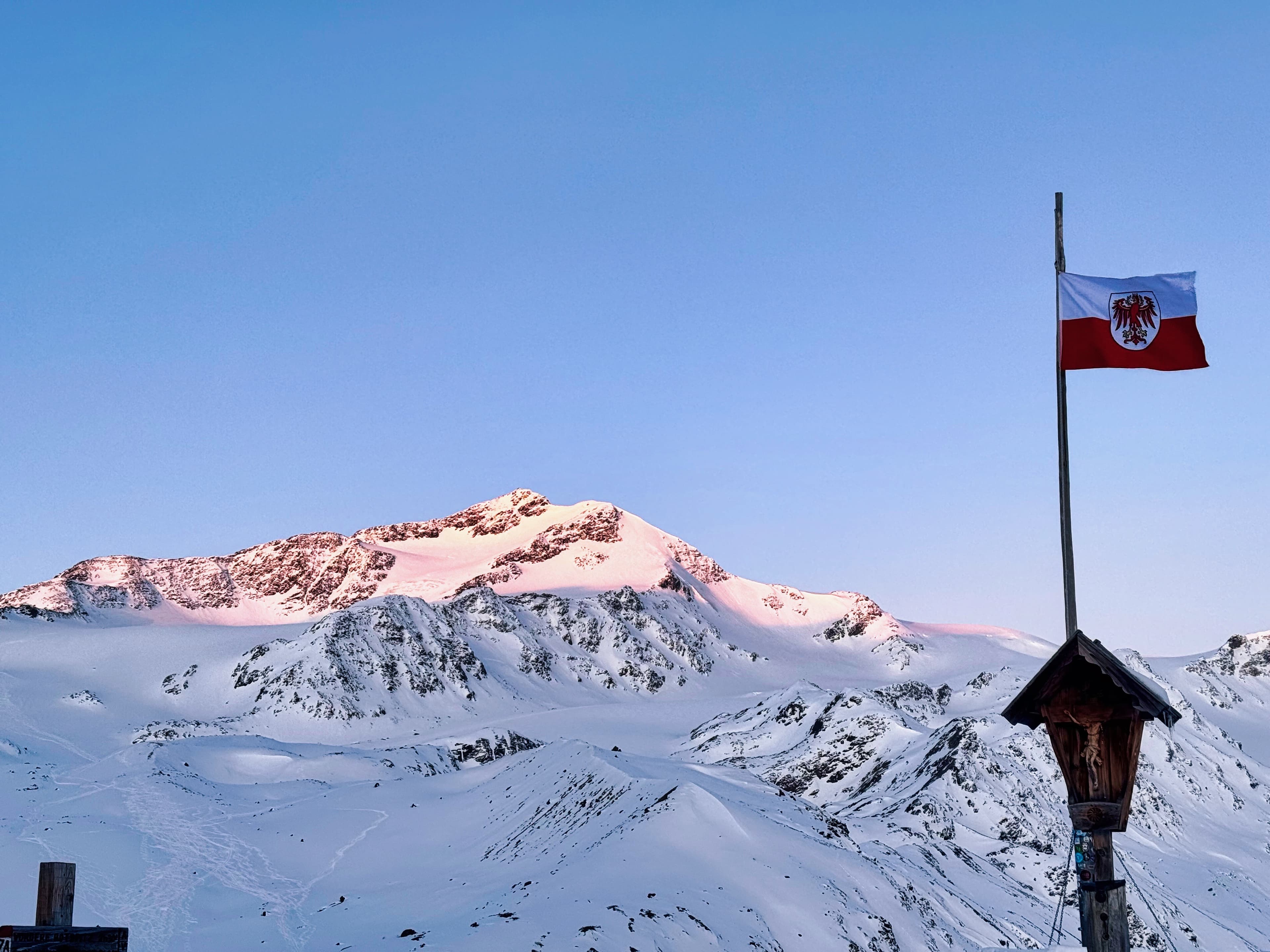
I have a problem with leaving.
Not the act itself — the tickets, the bags, the logistics. Those I can manage. The problem is what I'm leaving behind, and whether I'm honest enough with myself about why I keep going. My wife understands. My kids are getting old enough to understand. That doesn't make it easier.
LAX to London. London to Zürich. I've done enough of these overnight flights that the exhaustion is familiar — not tiredness exactly, more like a controlled dissociation. You surrender a night of your life to an aluminum tube and wake up somewhere that isn't home. I've always found this clarifying. Some people find it disturbing. I'm not sure what that says about either of us.
The train south from Zürich toward Landeck cuts through Switzerland and then into Austria, and I sit in business class feeling fraudulent. Around me: older German-speaking women, books open, knitting needles moving, completely at ease in the way that Europeans are at ease in transit — unhurried, untethered from productivity. I have a ski bag in the overhead rack and a touring pack at my feet and I'm wearing the kind of technical clothing that announces itself. Nobody says anything. Nobody needs to.
I've arranged a driver at Landeck. We share almost no language. He loads my gear without ceremony and drives. Somewhere south of the border crossing into Italy, he waves at someone on the street. "My hometown," he says, carefully. We don't speak again for the next ninety minutes. This suits me fine.
Sölden sits in a valley in South Tyrol that doesn't feel Italian because it isn't, not really. Austria surrendered it after the First World War. The Italian flags are absent. The Tyrolean eagle flies instead. German is the first language. Schnitzel is on every menu. It is a region with a grievance embedded in its geography, and the mountains here — massive, serious, indifferent — seem to express that grievance more honestly than any flag could.
The hotel is the Julius Payer, named for the man who mapped these mountains in the 19th century. I look him up on my phone: Austrian explorer, arctic expedition leader, a man who went to genuinely dangerous places and came back. Reinhold Messner — arguably the greatest alpinist in history, the first to solo Everest, the first to climb all fourteen eight-thousanders — learned to climb on the Ortler, the highest peak in South Tyrol, visible from this valley. You can feel it. Some places press their history into you whether you want it or not.
My roommate for the first night is an ER doctor from Tahoe, late forties, immediately likeable. Fit in the specific way that people who've spent decades climbing and ski touring are fit — not gym-fit, genuinely fit, the kind that doesn't show off because it doesn't need to. He checks his avalanche beacon three times before dinner. Then once more after. He talks quietly to himself while he does it. I find this reassuring rather than alarming. The people who take safety equipment seriously are the ones I want next to me on a steep slope in uncertain conditions.
Our guide is Dave Miller, early sixties, out of Mammoth. He has the economy of language that experienced guides develop — he says what needs to be said and nothing more. I respect this immediately. The guides who talk too much are usually covering for something.
The fourth member of our group is a banker from Leadville, Colorado. Tall, bearded, cowboy hat. He's older than the rest of us, maybe sixty, and lives at ten thousand feet, which will matter on the climbs. He tells us at dinner that he sometimes breaks into Sound of Music in the mountains. He is not joking.
I am already glad I came.
Day One
The lifts are the last concession to comfort we'll make for six days. Two of them, carrying us to the top with a crowd of resort skiers in gear that costs more than some cars. Then we peel off the groomed runs and into the backcountry, and the noise drops away immediately. This is what I come for — not the silence exactly, but the specific quality of attention that silence demands.
We ski down under a bluebird sky to the Zufallhütte — Rifugio Nino Corsi — where cappuccino and strudel are served on a sun-deck at altitude, which is either absurd or perfect depending on your disposition. I decide it's perfect. On the far end of the deck, a group of young Germans in technical climbing gear stare at something above us. I follow their gaze.
Cevedale. 3,769 meters. Our objective for tomorrow.
It is not a small mountain.
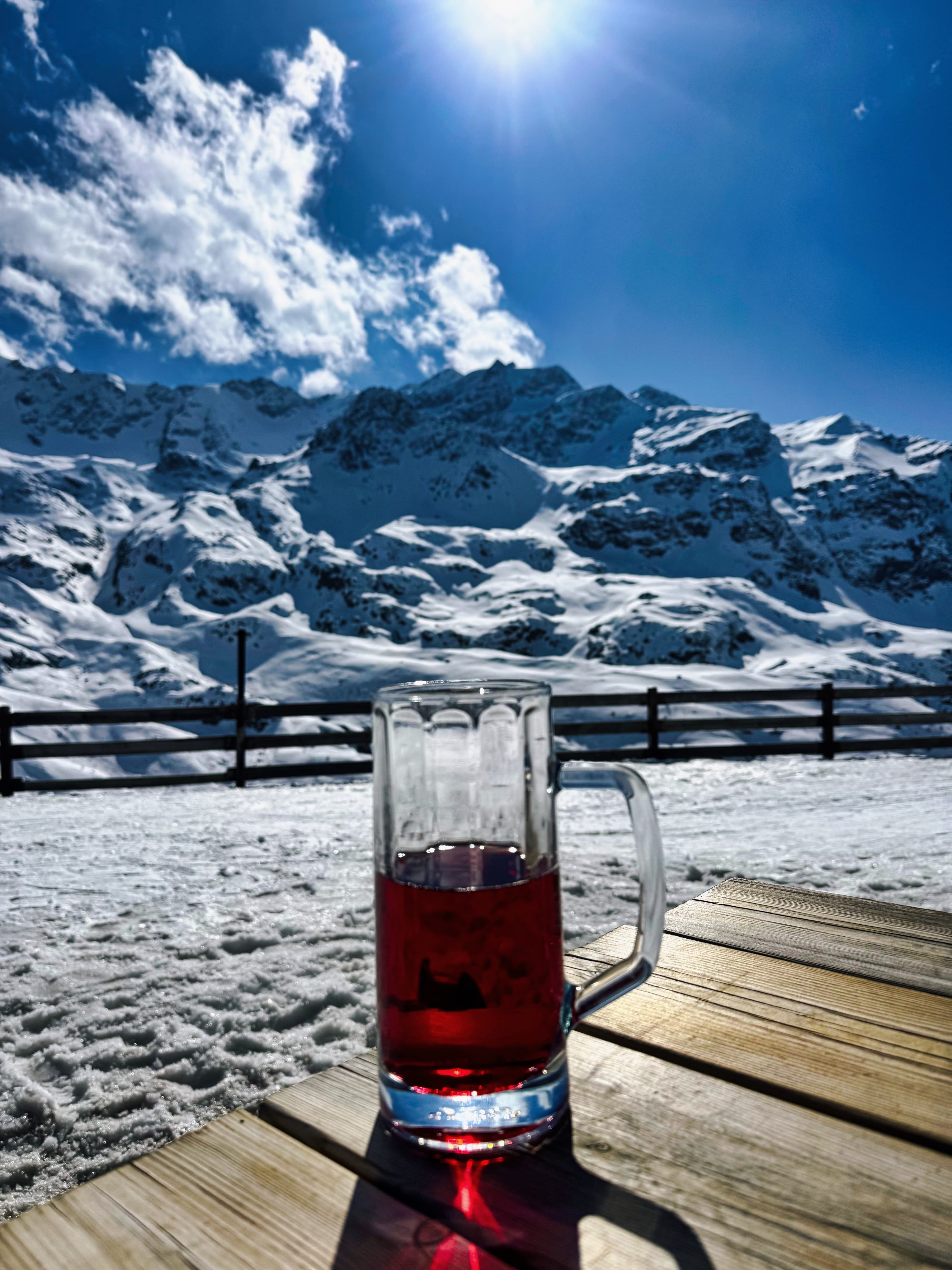
I order a Skiwasser — sparkling water with raspberry syrup, the unofficial non-alcoholic drink of the alpine huts, served in a heavy glass mug. I sit with it and with the view and with the particular feeling that arrives sometimes when you've traveled very far from your ordinary life and landed somewhere that justifies the distance. I flew alone from Los Angeles. I crossed three countries on a train. I rode ninety minutes in near silence with a man whose hometown I passed through without knowing it. I am sitting here now, staring at a mountain I intend to climb tomorrow, and I do not feel the need to be anywhere else.
Took a photo of Cevedale for Erin. Middle of the night at home.
This feeling is what I'm chasing. I don't always find it. Today I did.
The skin up to Marteller Hütte is our first real work of the trip. Dave sets a pace that is measured and deliberate — he's done this long enough to know that ego kills trips before the mountain does. The doctor moves fluidly, effortlessly, as if the climbing is something his body has simply decided to do. The banker is slower, technique loose, but at home in his body in the way that people who live at altitude are — unhurried, unconcerned. I am somewhere in the middle, feeling the elevation in my lungs. I came from sea level two days ago. My body is reminding me of this.
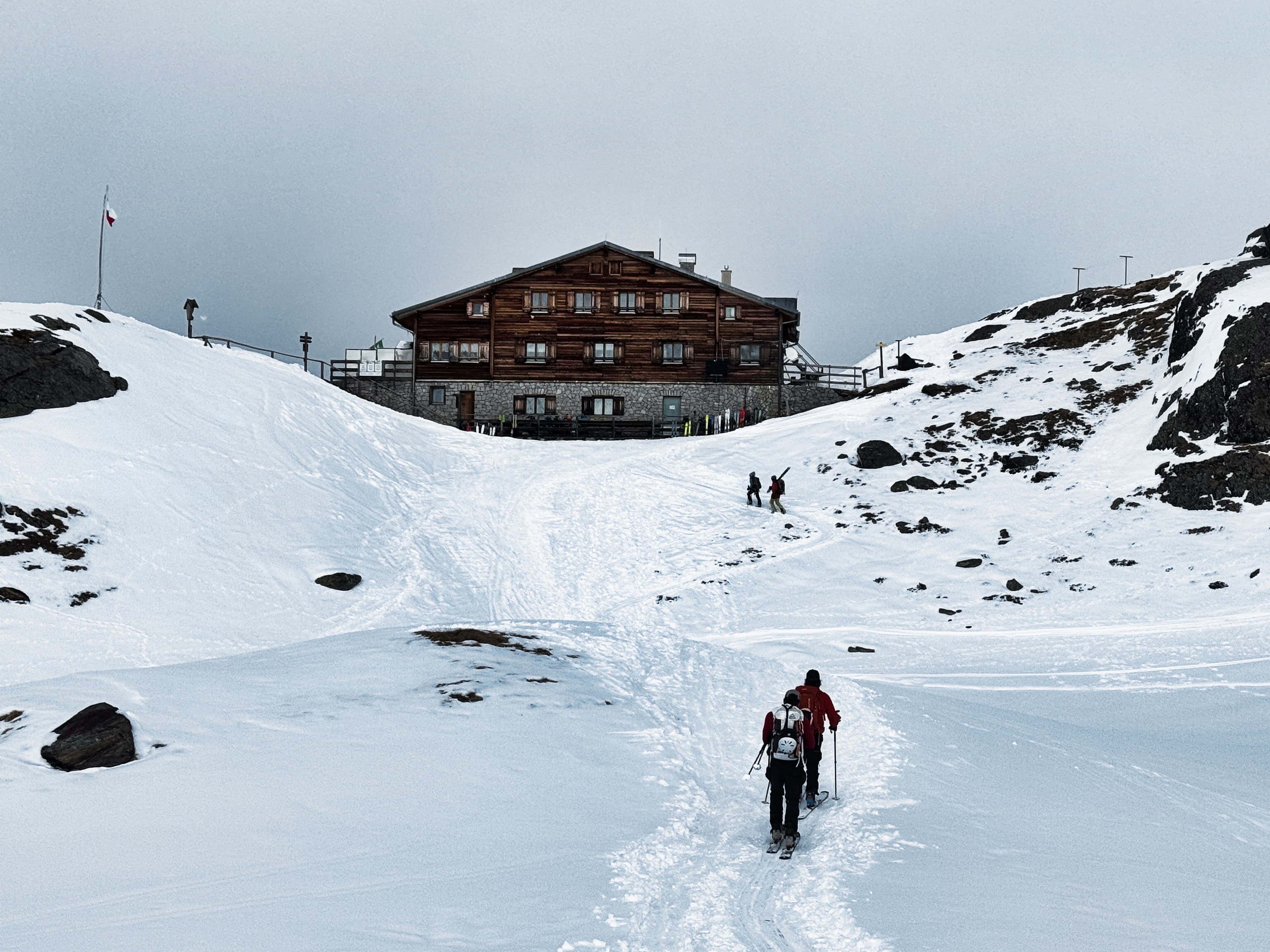
The hut appears suddenly — they always do — a stone building set impossibly into the mountain, organized with the particular efficiency of people who have thought seriously about what altitude does to the unprepared. Boots off at the door. Communal crocs from a sled. Ice axes racked. Skis in the ski room. Everything in its place. I find this deeply satisfying in a way I don't entirely understand.
The South Tyrolean flag snaps above the entrance. Beside the door, a small shrine — Christ on the cross, flowers at the base, weathered by seasons. These shrines are everywhere in the Alps. They mark the places where things have gone wrong before. They are not decorative.
On the deck, Europeans of a half-dozen nationalities drink beer in the long afternoon shadow of Cevedale. Nobody is looking at their phone. This is worth noting because it is increasingly unusual and because the mountain is partly responsible — you can't look at your phone when you're looking at that.
Dinner at 6:30. No exceptions. An appetizer, pasta, a main course, dessert. The dining room is loud with overlapping languages and warm with the specific warmth of people who have earned their meal with their legs.
Someone asks where we're from. Americans, we say.
A pause. "But why do you come all the way here? Don't you have skiing in America?"
It is a fair question. The honest answer is complicated and not entirely flattering. Something about needing to be somewhere that my ordinary life cannot reach me. Something about mountains that formed people, not just landscapes. Something about sitting at a table with three strangers and feeling more present than I do most days at home.
I don't say any of this. I say the skiing is extraordinary.
The banker orders a beer and sets his cowboy hat on the table. Dave studies tomorrow's weather with the focused attention of someone for whom weather is not background. The doctor checks his beacon again. I look out at Cevedale in the fading light and think about the long way I've come to be sitting in this chair, in this place, with these specific people I didn't know a week ago.
It is, for now, exactly enough.